

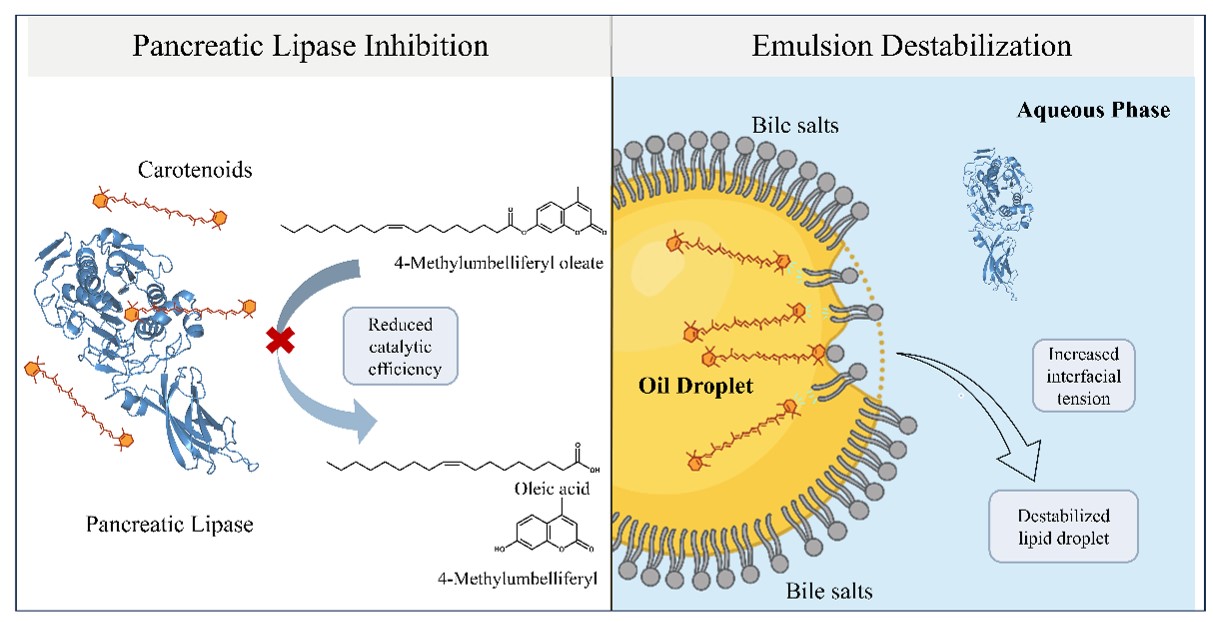
Recently, researchers from Fruit Nutrition and Function Team at the Zhengzhou Fruit Research Institute, Chinese Academy of Agricultural Sciences, revealed that carotenoids exert their regulatory effect on lipid digestion through two mechanisms: directly inhibiting the pancreatic lipase activity and interacting with bile salts to disrupt the stability of the oil-water interface. The findings have been published in Food Chmeistry (JCR Q1, IF=10.4). Junkun Pan is the first author, and Qiang Zhang and Zhonggao Jiao are co-corresponding authors.
Approximately 40% of the global population is overweight or obese. Excessive lipid intake is a major dietary factor contributing to obesity and related metabolic disorders. Therefore, regulating intestinal lipid digestion is regarded as an important way to manage excess body fat and promote metabolic health. The clinically used anti-obesity drug orlistat mainly acts on the latter process by inhibiting the activity of pancreatic lipase. Moreover, orlistat is frequently associated with side effects including gastrointestinal discomfort, steatorrhea, renal injury, and increased risk of osteoporosis. Therefore, the natural sources of lipase inhibitors has become a research hotspot. Carotenoids are a large class of lipid-soluble terpenoid pigments widely distributed in nature, and they are generally classified into carotenes and xanthophylls. It has attracted much attention due to its outstanding antioxidant activity and various physiological functions. In recent years, it has been found to have the potential to inhibit lipase, but the specific mechanism of action is still unclear.
This study explored the effects of four common carotenoids (lutein, zeaxanthin, lycopene, and β-carotene) on lipid digestion using simplified in vitro model systems from biochemical and interfacial perspectives. Lutein showed noncompetitive inhibition of pancreatic lipase, whereas zeaxanthin, lycopene, and β-carotene exhibited mixed-type inhibition. Spectroscopy and molecular simulation showed that these carotenoids can directly interact with pancreatic lipase, altering its structure and reducing activity. At the oil-water interface, the presence of carotenoids significantly decreased the release of free fatty acids, destabilized bile salt-stabilized emulsions, increased interfacial tension, and reduced emulsion viscosity, phenomena largely arising from interactions between carotenoids and bile salts. Isothermal titration calorimetry combined with oil-water interface dynamics simulation revealed carotenoids binding to bile salts, with lutein and zeaxanthin displaying stronger affinities than lycopene and β-carotene. These findings indicate that carotenoids may modulate lipid digestion through two possible mechanisms.
This discovery offers new ideas for the development of functional foods or dietary plans based on natural ingredients from fruits and vegetables.
This work was supported by the Science and Technology Innovation Project of the Chinese Academy of Agricultural Sciences and the National Key Research and Development Program.
Original link: https://doi.org/10.1016/j.foodchem.2026.150130
By Zhang Qiang
Zhangqiang02@caas.cn