

Seed size is an important agronomic trait in crop domestication, with significant implications for improving crop quality and yield, and it is a core breeding target in watermelon improvement. However, the key genetic variations that determine watermelon seed size and the underlying molecular regulatory mechanisms remain largely unknown, which has greatly hindered the development of small seeded table watermelon varieties.
Recently, the Watermelon and Melon Germplasm Resources Team of the Zhengzhou Fruit Research Institute, Chinese Academy of Agricultural Sciences, published an online research paper in Plant Communications (IF=13.7) titled “A copy number variation generates a long-noncoding RNA that enhances ClBige1b expression to suppress cell expansion and seed growth in watermelon.” By performing SV GWAS analysis on 196 watermelon core accessions, the researchers pinpointed a copy number variation (CNV) on chromosome 6 that highly associated with seed size. Genomic comparison revealed that this CNV exists as a single copy in large seeded accessions but as a four copy tandem repeat in small seeded ones. Further molecular interaction assays and gene editing experiments demonstrated that although this variation does not directly encode any protein, it directly activates a novel long non coding RNA, which in turn upregulates a downstream gene encoding a multidrug and toxin extrusion transporter. This suppresses cell expansion by reducing auxin levels, ultimately leading to smaller seeds. This discovery establishes, for the first time, a link between copy number variation, long non coding RNA, and seed size regulation, providing a directly exploitable gene target for molecular breeding of small seeded watermelon varieties. It holds significant guiding value for developing small seeded watermelons that better meet consumer market preferences.
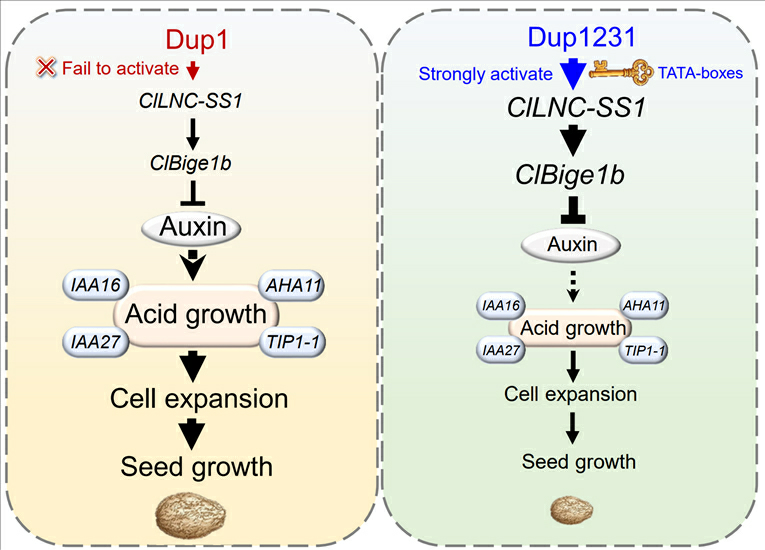
Figure. Molecular mechanism of copy number variation regulating watermelon seed size
Professor Na Li from the Zhengzhou Fruit Research Institute, Chinese Academy of Agricultural Sciences, is the corresponding author of this study. Dr. Jianfei Song and Assistant Researcher Dan Zhou from the Zhengzhou Fruit Research Institute, as well as Associate Researcher Jianshu Zheng and Research Assistant Zhanpeng Tang from the Agricultural Genomics Institute at Shenzhen, Chinese Academy of Agricultural Sciences, are co first authors of the paper. This work was supported by the Agricultural Science and Technology Innovation Program of the Chinese Academy of Agricultural Sciences and other funding sources.
Original link: https://doi.org/10.1016/j.xplc.2026.102028
By Li Na and Song Jianfei
lina01@caas.cn, songjianfei@caas.cn