

Recently, the Peach Germplasm Resources and Breeding Innovation Team of Zhengzhou Fruit Research Institute, Chinese Academy of Agricultural Sciences, has systematically elucidated the genetic basis underlying the co-segregation of flesh color, astringency, and acidity in red-fleshed peach, providing a solid theoretical foundation and key targets for molecular breeding of red-fleshed peach. The findings were published in 《Molecular Horticulture》.
Red-fleshed peach, characterized by its vibrant red color due to anthocyanin accumulation in the flesh, possesses both visual appeal and antioxidant health benefits, making it an important target for peach breeding improvement. However, the accumulation of anthocyanins in red-fleshed peach is often accompanied by astringency caused by proanthocyanidins and high fruit acidity. The sensory defect of "beautiful but unpalatable" severely limits its commercial value.
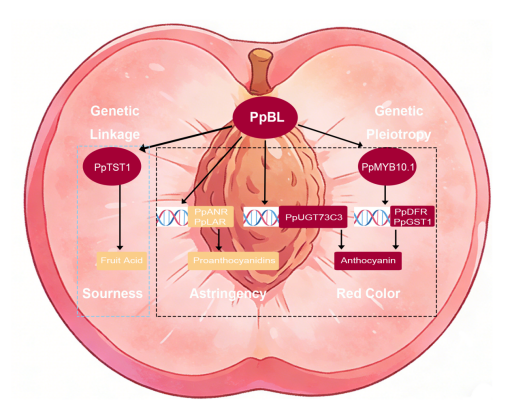
The study revealed that the transcription factor PpBL functions as a master switch, coordinately regulating anthocyanin and proanthocyanidin accumulation by directly activating key genes including PpUGT73C3, PpANR, and PpLAR, thereby simultaneously influencing flesh color and astringency. The association between red flesh and high acidity, however, stems from genetic linkage between PpBL and the acidity-regulating gene PpTST1 on chromosome 5, rather than from gene pleiotropy. To address these findings, different breeding strategies can be adopted in the future: for pleiotropic regulation, fine-tuning PpBL activity could attenuate its activation of proanthocyanidin synthesis; for genetic linkage, gene editing or marker-assisted recombination could be employed to break the undesirable linkage, ultimately achieving the ideal cultivar with "high anthocyanin, low astringency, and moderate acidity."
This research was supported by the National Key Research and Development Program, the National Natural Science Foundation of China, and the Agricultural Science and Technology Innovation Program of the Chinese Academy of Agricultural Sciences.
By Xing Hongyang & Wang Lirong
wanglirong@caas.cn